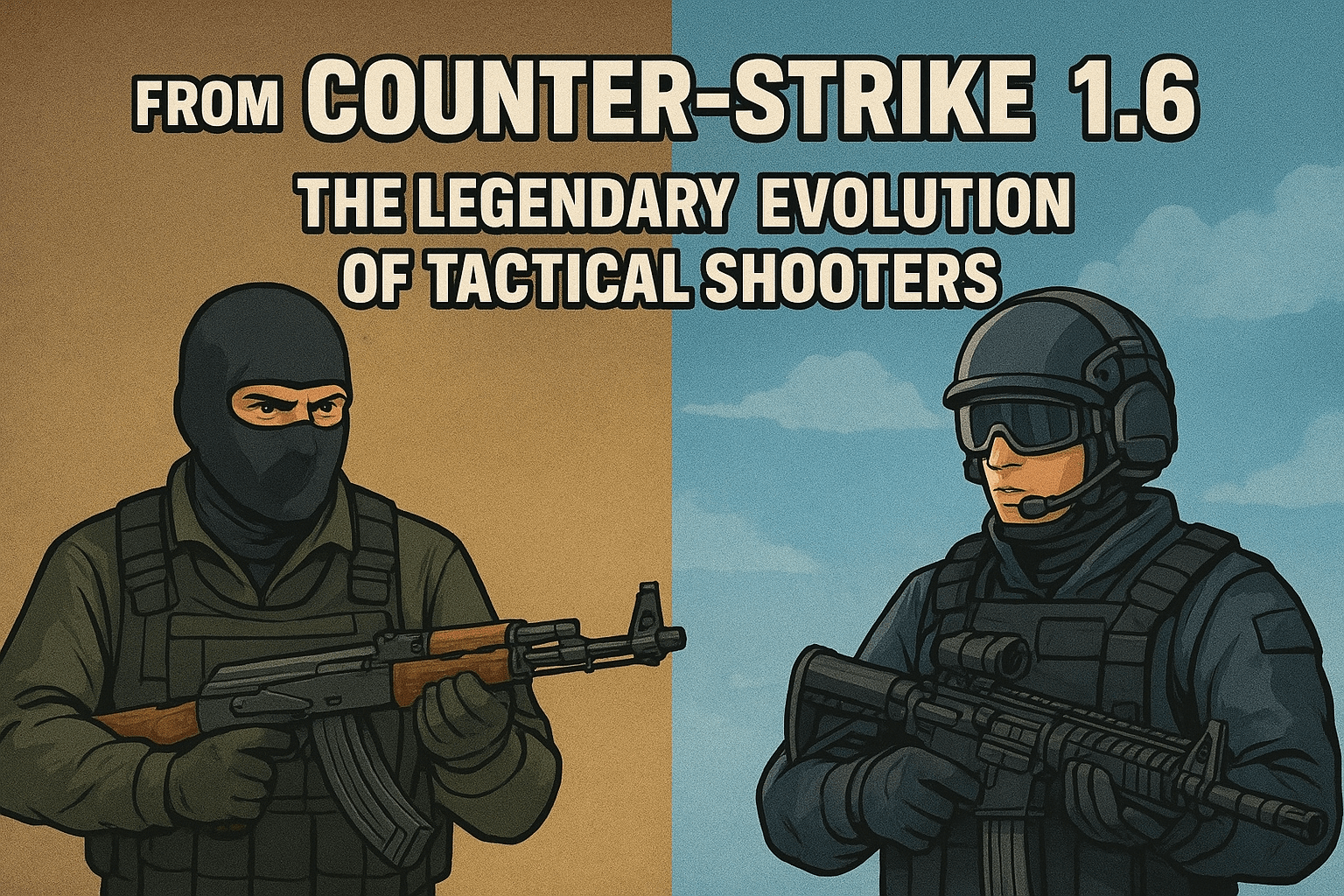
Few games have shaped the FPS genre like Counter-Strike. What started as a student-made mod in the late ’90s has now transformed into a billion-dollar esports phenomenon. The path from CS 1.6 to CS2 isn’t just about graphics or updates—it’s a story of culture, competition, and community.
🔥 The Birth of Counter-Strike (1999–2000)
Back in 1999, two developers, Minh “Gooseman” Le and Jess Cliffe, built a modification of Valve’s Half-Life. They wanted something realistic—where teamwork and tactics mattered more than pure speed. This experiment turned into Counter-Strike Beta, and by 2000, Valve officially acquired it.
Almost overnight, CS 1.6 became the face of PC multiplayer. Cyber cafés across Asia, Europe, and South America were packed with players yelling “rush B” or “save the AWP.” For many, this was the first taste of competitive online gaming.
🎮 Counter-Strike 1.6 — The Golden Standard
Ask any veteran gamer, and they’ll tell you CS 1.6 was magic. Why?
- Simplicity with mastery → Easy for beginners but endless skill ceiling.
- Maps that became icons → Dust2, Inferno, Nuke, Train—each had its own identity.
- Weapon identity → The AK-47 one-tap, the AWP flick shot, the M4A1 spray—all unforgettable.
- LAN culture → College tournaments, café rivalries, and the rise of local heroes.
For over a decade, CS 1.6 defined tactical shooters. Even when newer versions arrived, many refused to switch.
🌐 Counter-Strike: Source — A Divided Community
In 2004, Valve introduced CS: Source, powered by the new Source Engine. It looked better, had physics-based grenades, and smoother animations. But the community was split.
Pro players argued Source felt “floaty” compared to 1.6. Competitive tournaments stuck with the older version, while casual players embraced the shiny graphics. In many ways, CS:S became an experimental bridge rather than a true replacement.
🚀 CS:GO — From Underdog to Esports Titan
When Counter-Strike: Global Offensive launched in 2012, expectations were low. The community was skeptical, especially die-hard 1.6 and Source fans. But Valve kept updating the game, listening to feedback, and slowly building a future.
What changed everything?
- 🎮 Weapon skins & marketplace → Suddenly, guns became collectibles. Some rare knives and skins sold for thousands of dollars.
- 🏆 Professional scene → ESL One, DreamHack, and Major tournaments turned CS:GO into a multi-million-dollar esport.
- 🌍 Global reach → From Europe to Asia to the Americas, CS:GO united players worldwide.
By 2020, CS:GO wasn’t just a game—it was an esports empire with millions of active players and Twitch viewership rivaling the biggest games.
⚡ Counter-Strike 2 — A New Era (2023–Present)
In 2023, Valve unveiled Counter-Strike 2, built on the powerful Source 2 engine. Unlike past transitions, this time the goal was to upgrade without breaking tradition.
Major innovations included:
- Responsive smokes → Now reacting to bullets, blasts, and environment.
- Sub-tick servers → Ultra-precise shooting mechanics for competitive balance.
- Visual overhauls → Classic maps rebuilt with modern lighting and textures.
- Free-to-play accessibility → Ensuring anyone could join the battlefield.
CS2 is more than just a sequel—it’s Valve’s promise that Counter-Strike will remain relevant for another decade.
🌍 Impact Beyond Gaming
Counter-Strike isn’t just a shooter—it’s a cultural phenomenon. It taught players:
- Teamwork > solo play.
- Economy matters (buy or save, win or lose).
- Precision aiming is a skill, not luck.
It inspired entire generations of games like Valorant and Rainbow Six Siege, proving that tactical shooters never go out of style.
📅 Evolution Timeline
- 1999 → Counter-Strike Beta mod released.
- 2000 → Official CS 1.6 release; dominates LAN cafés.
- 2004 → Counter-Strike: Source launches.
- 2012 → CS:GO released; esports boom begins.
- 2023 → Counter-Strike 2 ushers in the new era.
🤯 Fun Facts You Didn’t Know
- Dust2 is so iconic that it’s referenced in memes, movies, and even non-gaming discussions.
- The phrase “clutch or kick” originated from CS community servers.
- The most expensive CS:GO skin ever sold crossed $150,000.
- Some pro players still train on CS 1.6 for raw aim practice.
🔮 The Future of Tactical Shooters
While games like Valorant may compete, Counter-Strike has something others lack: two decades of legacy. With CS2, Valve isn’t just upgrading graphics—it’s ensuring Counter-Strike continues to be the benchmark for tactical shooters worldwide.
✅ Final Words
From dusty LAN cafés filled with 1.6 nostalgia to modern arenas streaming CS2 finals to millions, the journey of Counter-Strike is unmatched. It has grown with its community, adapted with technology, and yet stayed true to its roots: strategy, teamwork, and pure skill.
The story from CS 1.6 to CS2 is proof that legends don’t fade—they evolve.