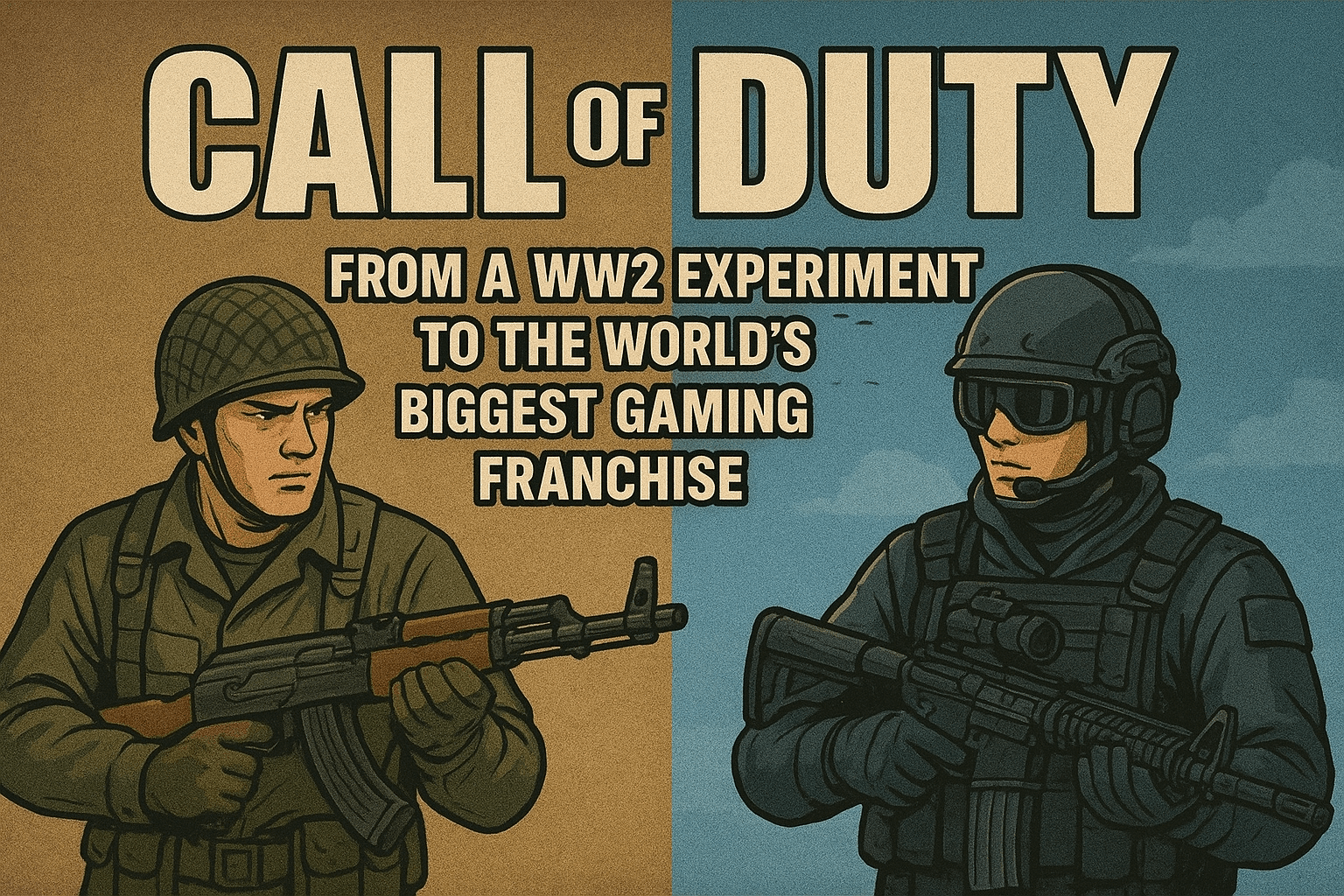
If there’s one video game name almost everyone has heard of, it’s Call of Duty (COD). What started as a simple World War II shooter back in 2003 has grown into a massive entertainment empire, competing with movies and music in terms of revenue and global recognition. COD is not just a game anymore—it’s a brand, a tradition, and for many, a lifestyle.
🔰 The Beginning: Infinity Ward’s First Mission
The story begins with Infinity Ward, a studio created by developers who had earlier worked on Medal of Honor: Allied Assault. They wanted to design something more immersive and cinematic, where players didn’t feel like lone soldiers but part of a chaotic battlefield.
In 2003, the first Call of Duty dropped. It stood out because of its squad-based gameplay, explosive action, and realistic sound design. For the first time, a war game felt like you were inside a Hollywood war film.
⚔️ The World War II Era (2003–2006)
The first three games—COD, COD 2, and COD 3—focused entirely on World War II. Players stormed beaches, defended villages, and recreated historical battles.
- Call of Duty 2 (2005) became a smash hit, even helping boost sales of the newly launched Xbox 360.
- Call of Duty 3 (2006) added more cinematic flair but kept its WW2 roots.
But just when people thought COD would always stick to history, the franchise took a bold leap forward.
🚀 The Turning Point: Modern Warfare (2007)
The real revolution came with Call of Duty 4: Modern Warfare. Released in 2007, it completely reshaped what people expected from a first-person shooter.
- Introduced modern weapons, killstreaks, and perks.
- Legendary characters like Captain Price and Soap MacTavish became household names.
- Multiplayer became the franchise’s backbone, creating a competitive online scene that dominated living rooms and internet cafés alike.
COD4 was more than a game—it was a cultural shift. Every shooter after 2007 was compared to Modern Warfare.
🌍 Multiple Studios, Multiple Stories
As the franchise grew, Activision decided to rotate development across three studios:
- Infinity Ward handled the Modern Warfare series.
- Treyarch brought us the iconic Black Ops series and the fan-favorite Zombies mode.
- Sledgehammer Games experimented with futuristic titles like Advanced Warfare and co-developed Modern Warfare 3.
This rotation meant COD could release a new game every single year, keeping fans hooked and the hype alive.
🧟 Zombies, Black Ops & Risk-Taking
One of the most surprising successes came from Treyarch’s Zombies mode, originally just a bonus in World at War (2008). It grew into a full-blown fan obsession, spawning lore, Easter eggs, and dedicated communities.
Meanwhile, Black Ops (2010) pulled players into Cold War conspiracies, brainwashing experiments, and spy missions—adding a psychological twist never seen before in shooters.
Not every risk worked (Infinite Warfare’s space setting divided fans), but the experiments kept COD fresh.
🎯 Warzone & The Free-to-Play Revolution (2020)
In 2020, COD shocked the industry again with Warzone, a free-to-play battle royale. Competing with Fortnite and PUBG, it gave players a huge open map, cross-platform play, and constant updates.
Warzone wasn’t just a spin-off—it was a cultural moment. Millions of new players joined COD for the first time, streamers built careers around it, and Activision discovered the power of free-to-play gaming.
🌐 COD in Esports & Pop Culture
The Call of Duty League (CDL) turned COD into a professional esport with international teams and massive prize pools. On Twitch and YouTube, personalities like Scump, Nadeshot, and NickMercs turned COD into a spectator sport.
Beyond gaming, COD left its mark on culture:
- Quotes like “1v1 me on Rust” became internet slang.
- COD campaigns sparked controversy (Modern Warfare 2’s “No Russian” mission).
- Celebrities like Snoop Dogg and Kevin Spacey even made appearances in games.
🤯 Did You Know?
- COD has sold over 425 million copies, making it one of the best-selling franchises ever.
- It has generated over $30 billion in revenue—bigger than many Hollywood franchises.
- The games have featured unexpected guest stars, from actors to rappers.
🔮 The Future of Call of Duty
With Modern Warfare II (2022) and Warzone 2.0, COD shows no signs of slowing down. Future entries may explore VR, cinematic storytelling, and deeper esports integration.
As technology grows, one thing is certain: Call of Duty will keep adapting and remain at the top of gaming.
✅ Final Thoughts
From storming Normandy in WW2 to battling it out in Warzone, Call of Duty has done it all. It’s more than a franchise—it’s a timeline of how shooters evolved, how online gaming exploded, and how games became part of everyday culture.
Whether you loved the old-school campaigns or thrive in Warzone lobbies, COD is here to stay. And its journey from a simple WW2 shooter to the world’s biggest gaming empire is nothing short of legendary.