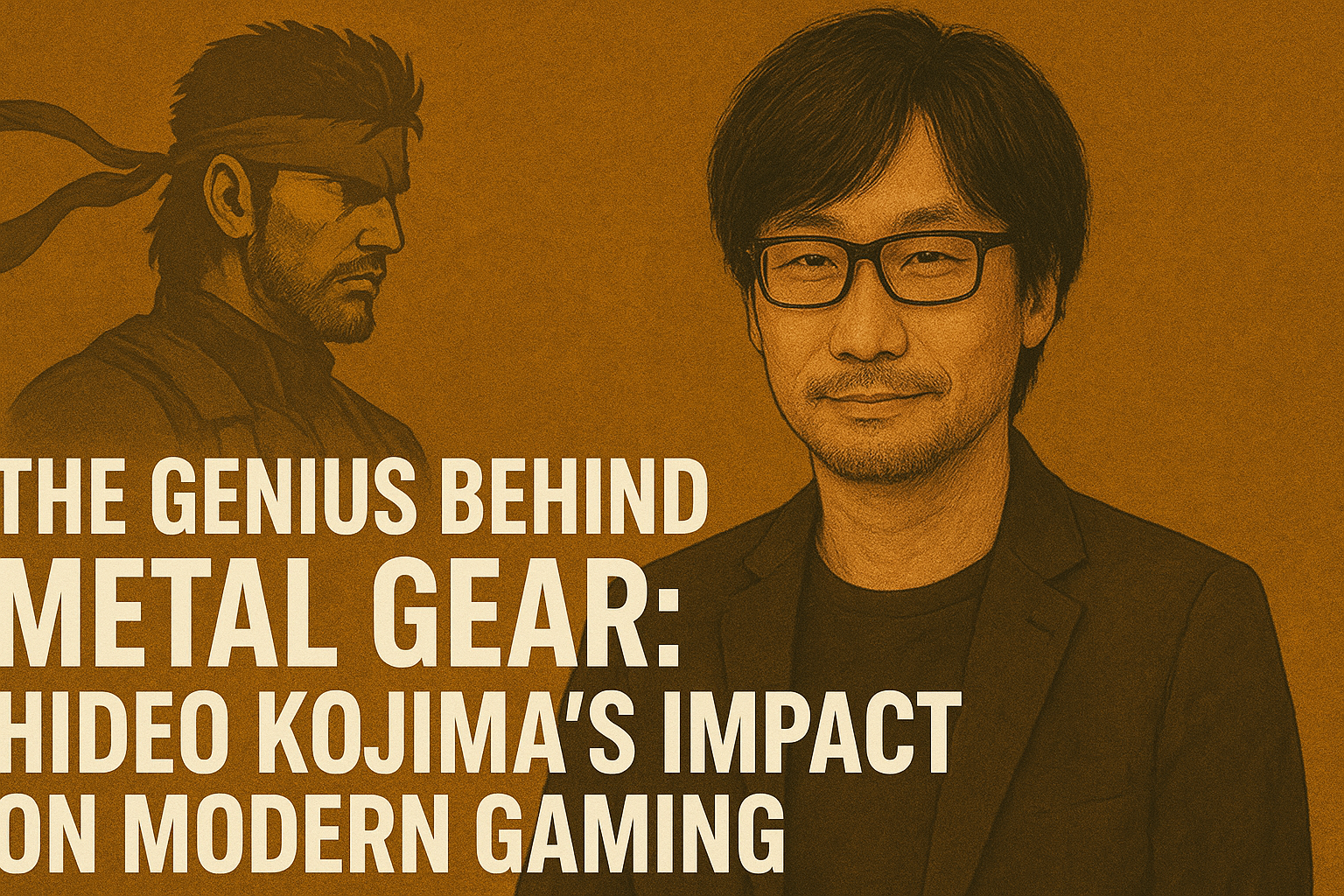
When people talk about the most influential game creators of all time, one name always stands out — Hideo Kojima. Known for his groundbreaking Metal Gear series, Kojima is not just a game developer, but a storyteller, visionary, and auteur who reshaped how the world views video games. From stealth mechanics to cinematic storytelling, his work has inspired generations of developers and players alike.
🌱 Early Life & The Dream of Storytelling
Hideo Kojima was born in 1963 in Tokyo, Japan. From a young age, he was fascinated by movies, literature, and storytelling. While many saw video games as “toys,” Kojima believed they could become a serious medium for art and narrative.
He joined Konami in the 1980s as a designer, where he pitched several ambitious projects. Although some early ideas were rejected, his passion and persistence would soon pay off.
🕵️ The Birth of Metal Gear (1987)
In 1987, Kojima directed the original Metal Gear for the MSX2 computer. Unlike most action games at the time, Metal Gear introduced something revolutionary:
- Stealth over combat → Instead of running and shooting, players had to avoid enemies, hide, and think strategically.
- Narrative depth → The game blended action with espionage storytelling, making players feel part of a bigger mission.
This stealth-action genre would become Kojima’s signature and inspire countless future games.
🎬 Metal Gear Solid: Cinema Meets Gaming
The breakthrough moment came in 1998 with Metal Gear Solid on the PlayStation. It wasn’t just a game — it was an interactive movie.
- Cutscenes & voice acting: For the first time, players experienced professional-level storytelling in a game.
- Themes of politics & war: Kojima used the game to explore nuclear proliferation, surveillance, and the human cost of conflict.
- Complex characters: From Solid Snake to Liquid Snake and Psycho Mantis, Kojima gave players memorable heroes and villains.
Metal Gear Solid proved that games could rival movies in terms of narrative and emotional depth.
🤯 Breaking the Fourth Wall
One of Kojima’s trademarks is his creative, mind-bending mechanics. In Metal Gear Solid, the boss fight against Psycho Mantis shocked players worldwide. To win, you had to switch your controller port because Mantis could “read your mind.”
Moments like this blurred the line between player and game, showing that Kojima was not afraid to experiment and challenge conventions.
🚀 Expanding the Saga
Kojima continued pushing boundaries with sequels:
- Metal Gear Solid 2: Sons of Liberty (2001) shocked fans by introducing Raiden as the main character, a bold narrative twist.
- Metal Gear Solid 3: Snake Eater (2004) took players back to the Cold War, blending survival mechanics with deep emotional storytelling.
- Metal Gear Solid 4 (2008) delivered one of the most cinematic experiences in gaming history, wrapping up Snake’s journey.
- Metal Gear Solid V (2015) brought open-world gameplay, freedom of choice, and tactical realism — though Kojima’s fallout with Konami left the story incomplete.
🎥 Kojima’s Unique Style
What makes Hideo Kojima different?
- Cinematic storytelling: Inspired by directors like Stanley Kubrick and Ridley Scott, Kojima treats every game like a film.
- Themes of identity & technology: His stories explore AI, genetics, war, and what it means to be human.
- Attention to detail: From codec conversations to tiny Easter eggs, his games reward curiosity.
- Breaking conventions: He refuses to follow trends — instead, he creates them.
🌍 Post-Metal Gear Era: Kojima Productions
After leaving Konami in 2015, many thought Kojima’s career might slow down. Instead, he founded Kojima Productions and partnered with Sony.
His first project, Death Stranding (2019), was divisive yet groundbreaking. It introduced a new genre, “Strand gameplay,” where connection and rebuilding society were central themes. Starring Norman Reedus, Mads Mikkelsen, and Guillermo del Toro, the game showed Kojima’s ability to merge Hollywood talent with gaming.
Now, with Death Stranding 2 and rumored projects in the works, Kojima continues to prove he’s still ahead of his time.
⭐ Legacy & Influence
Hideo Kojima’s impact on gaming is undeniable:
- He pioneered the stealth genre, inspiring games like Splinter Cell, Hitman, and Assassin’s Creed.
- He proved that video games can be artistic and cinematic, influencing modern storytelling.
- He built a global fanbase that views him as not just a developer, but an auteur.
- His work inspired academic studies, film discussions, and even industry-wide respect from non-gamers.
Kojima himself often says: “70% of my body is made of movies.” But in truth, his legacy shows that 100% of his heart belongs to games.
🎁 Fun Facts About Kojima
✨ Kojima originally wanted to be a film director, but gaming became his true canvas.
✨ He often includes his own cameo appearances in his games.
✨ Kojima’s Twitter is filled with movie reviews, music recommendations, and food photos — showing his eclectic taste.
✨ He is one of the few game developers recognized globally as a celebrity.
🏆 Final Thoughts
Hideo Kojima is more than just a game developer — he is a visionary artist who redefined the gaming medium. With Metal Gear, he taught the world that games could tell deep, cinematic stories. With Death Stranding, he proved he’s still innovating and breaking boundaries.
As gaming continues to evolve, one thing is certain: Kojima’s influence will echo through the industry for decades to come.