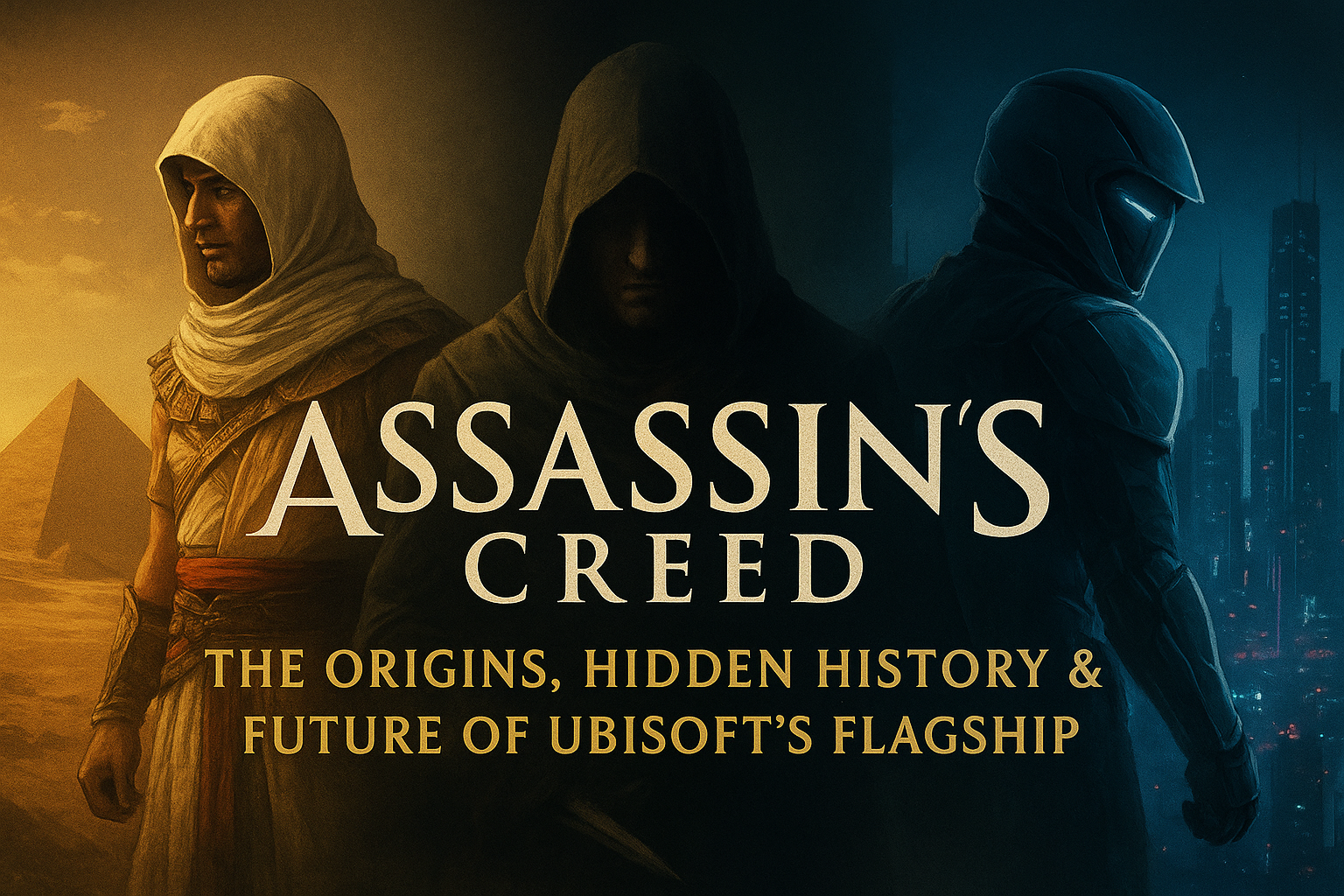
Few gaming franchises have left a legacy as deep as Assassin’s Creed. With its mix of history, stealth, and open-world freedom, it has sold over 200 million copies worldwide and become the crown jewel of Ubisoft. But Assassin’s Creed didn’t start as the giant we know today—it began as an experimental idea tied to another legendary series.
⚔️ The Origins: From Prince of Persia to Assassins
Back in the mid-2000s, Ubisoft wanted a fresh take on its Prince of Persia franchise. A small Montreal-based team, led by creative director Patrice Désilets, began working on a spin-off called Prince of Persia: Assassin. The concept was different: instead of focusing only on sword fights and puzzles, it introduced stealth, parkour, and freedom to explore.
Over time, the game evolved into its own identity, becoming Assassin’s Creed (2007). Players were thrown into the shoes of Altaïr Ibn-La’Ahad, a member of a secret brotherhood during the Third Crusade (1191 AD). The Animus—a device that lets users relive their ancestors’ memories—was introduced, connecting past and present.
This unique blend of historical fiction + sci-fi + freedom of movement made Assassin’s Creed an instant hit.
🏰 Hidden History & Evolution of the Franchise
The core charm of Assassin’s Creed has always been its historical settings. Ubisoft turned real cities and eras into living playgrounds:
- Assassin’s Creed II (2009) took us to Renaissance Italy, introducing the iconic Ezio Auditore da Firenze. His trilogy is still considered the peak of the series.
- Assassin’s Creed III (2012) explored the American Revolution, blending Native American culture with colonial politics.
- Black Flag (2013) let players live the life of a pirate assassin, revolutionizing naval combat in gaming.
- Origins (2017) rebooted the franchise, diving into Ancient Egypt with Bayek’s story, shifting gameplay towards RPG mechanics.
- Odyssey (2018) expanded into Ancient Greece, while Valhalla (2020) let players raid as Viking warriors.
Each installment carried Ubisoft’s signature: historical detail mixed with modern conspiracy lore, making players feel like time travelers.
🎮 Why Assassin’s Creed Became a Cultural Icon
- Parkour Freedom – Scaling cathedrals, pyramids, or Viking longhouses gave players unmatched freedom.
- History Reimagined – From Leonardo da Vinci helping you with inventions to fighting alongside George Washington, it blended history with fantasy perfectly.
- Stealth Meets Action – Hidden blades, disguises, rooftop escapes—it defined the stealth-action genre.
- Cinematic Storytelling – Assassin’s Creed felt like living inside a blockbuster movie.
🕵️ Hidden Layers: Lore Beyond the Games
Assassin’s Creed is not just about stabbing Templars—it’s a universe of lore. The mysterious First Civilization (Isu), Pieces of Eden, and the endless battle between Assassins and Templars gave depth that kept fans hooked for years.
Beyond games, Ubisoft expanded Assassin’s Creed into:
- Comics & Novels exploring side stories.
- A 2016 Hollywood movie (though fans weren’t too happy).
- Netflix series (upcoming), which promises to give the franchise another big boost.
📈 The Future of Assassin’s Creed
Ubisoft has confirmed that Assassin’s Creed is far from slowing down. Future plans include:
- Assassin’s Creed Mirage (2023–24): Returning to stealth-focused gameplay in Baghdad, with a back-to-roots approach.
- Assassin’s Creed Codename Red: Set in Feudal Japan, something fans have wanted for over a decade.
- Assassin’s Creed Codename Hexe: Rumored to explore the witch trials era in Europe, with a darker horror-like tone.
- Assassin’s Creed Infinity: A hub platform that connects future AC games under one umbrella, almost like a living “Assassin’s Creed universe.”
The roadmap shows Ubisoft’s intent to keep AC alive for another decade at least.
🤯 Fun Facts You Might Not Know
- Ezio’s trilogy was so loved that Ubisoft had to remaster it for modern consoles.
- The “Leap of Faith” was inspired by real-life stunt techniques.
- Assassin’s Creed II almost had Da Vinci as a playable assassin in early concepts.
- In 2014, Assassin’s Creed Unity recreated Notre-Dame Cathedral so accurately that architects used Ubisoft’s 3D model for restoration after the fire.
✅ Final Thoughts
Assassin’s Creed is more than just Ubisoft’s flagship—it’s a window into history, wrapped in thrilling gameplay. From Altaïr’s silent blade to Eivor’s Viking axe, every entry reflects not only technological progress but also our endless fascination with the past.
As long as gamers crave epic adventures and historical exploration, Assassin’s Creed will continue to shape the future of gaming.