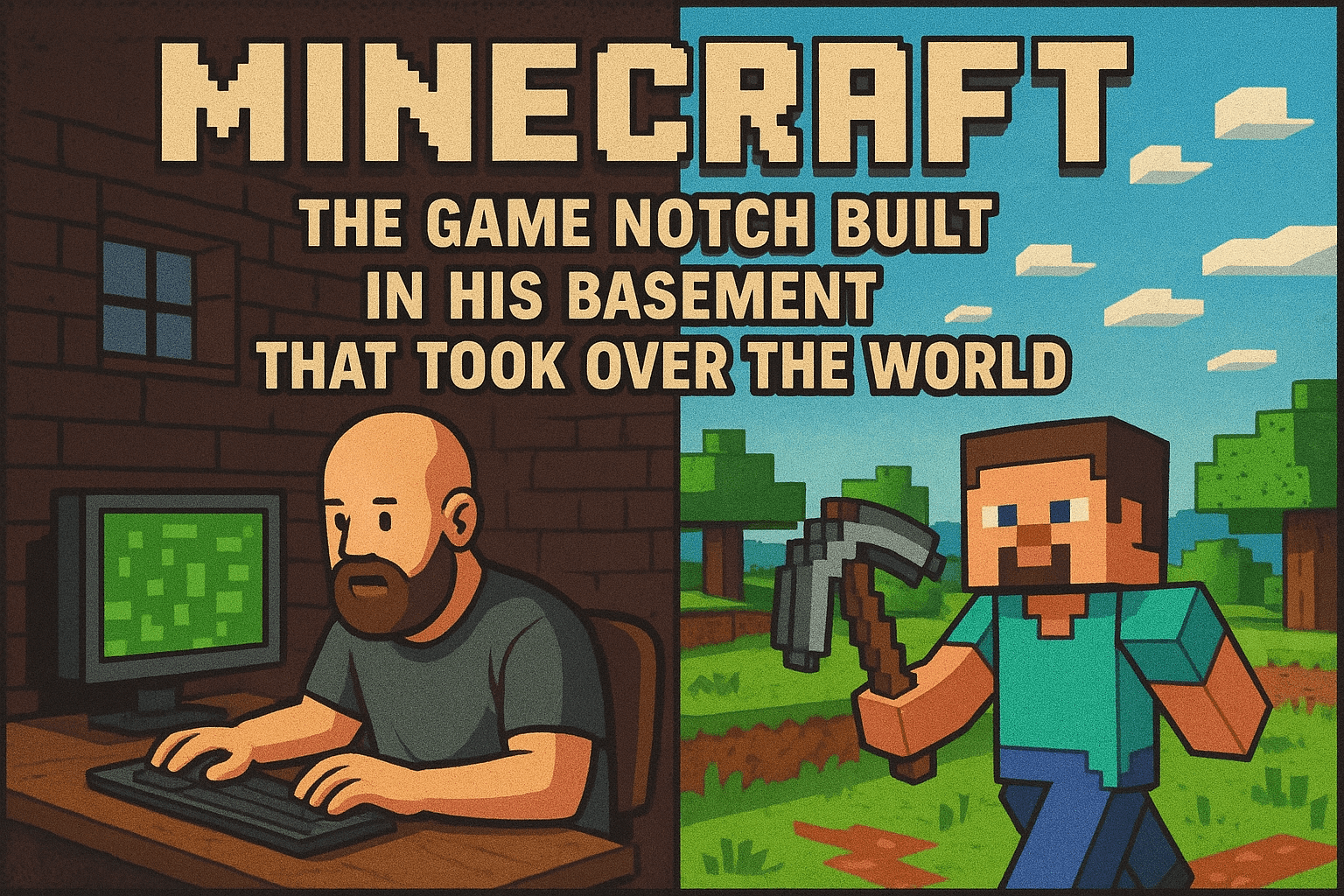
When we talk about video games that changed the culture of gaming forever, Minecraft sits at the very top. What started in 2009 as a side project by a single developer, Markus “Notch” Persson, soon became a global phenomenon. With its blocky visuals, endless creativity, and survival challenges, Minecraft proved that you don’t need flashy graphics to capture hearts—you just need freedom to play your way.
🌱 The Humble Beginning
Markus Persson, a Swedish programmer, was inspired by games like Dwarf Fortress and Infiniminer. Working alone in his free time, Notch started coding a sandbox game in his basement. His idea was simple:
- A world made entirely of blocks.
- Players could break those blocks and rebuild anything.
- No fixed goals—only creativity and survival.
On May 17, 2009, the first version of Minecraft was released as a paid alpha. It wasn’t polished, but players instantly loved the concept. Word spread through forums, YouTube, and early Let’s Play videos, and the fanbase exploded.
🛠️ From Indie Project to Worldwide Craze
By 2010, Minecraft had already gathered a cult following. Notch kept updating the game based on community feedback—adding features like crafting, monsters, redstone mechanics, and multiplayer servers.
Soon, the game’s popularity became unstoppable:
- Minecraft Beta (2010) introduced survival mode.
- Official Launch (2011) happened at MineCon in Las Vegas, drawing thousands of fans.
- By the end of 2011, Minecraft had sold millions of copies—without any big publisher backing it.
This was proof that community-driven development could rival billion-dollar gaming studios.
🏢 Mojang, Microsoft & The Big Buyout
Seeing the game’s massive success, Notch founded Mojang Studios to officially develop Minecraft. In 2014, something unbelievable happened—Microsoft bought Mojang and Minecraft for $2.5 billion.
This deal shocked the gaming world. How could a simple block game be worth billions? The answer:
- Its global player base.
- Educational potential.
- Its ability to constantly reinvent itself.
Under Microsoft, Minecraft only grew bigger with updates, cross-platform play, and spinoffs like Minecraft Dungeons.
🎮 Why Players Fell in Love With It
Minecraft’s magic lies in its simplicity and freedom:
- Creative Mode: Build castles, cities, or even computers—limited only by imagination.
- Survival Mode: Fight zombies, craft tools, and gather resources while surviving nights.
- Multiplayer Servers: From roleplay cities to battle arenas, communities made their own universes.
- Mods & Texture Packs: Players redesigned the game, adding dragons, futuristic tech, or even Pokémon.
For many, Minecraft became more than a game—it became a digital playground where childhood dreams came alive.
🌍 Minecraft’s Global Impact
- It became a favorite for YouTubers and streamers—PewDiePie, Dream, and Technoblade brought millions into Minecraft fandom.
- Schools adopted Minecraft: Education Edition to teach coding, teamwork, and problem-solving.
- The game inspired young developers to start modding, creating one of the biggest modding scenes ever.
- With over 300 million copies sold, Minecraft is the best-selling game in history, beating even Tetris and GTA V.
🤯 Fun Facts You Didn’t Know
- The first “Creeper” was actually a coding mistake while trying to create a pig.
- The Enderman’s speech is actually reversed English words.
- A block in Minecraft is roughly 1 cubic meter—meaning the largest builds are bigger than real-life cities.
- In 2020, Minecraft overtook YouTube as the most-watched gaming content with over 200 billion views in one year.
🔮 What’s Next for Minecraft?
Even after more than a decade, Minecraft is still evolving. With ray tracing, VR compatibility, and constant updates, the blocky world keeps feeling fresh. Rumors of a Minecraft movie and bigger esports-style competitions suggest that the brand is far from done.
The secret of Minecraft’s success is clear: It’s not just a game, it’s a platform for imagination.
✅ Final Thoughts
From Notch’s basement project to Microsoft’s billion-dollar empire, Minecraft’s journey is nothing short of legendary. It’s the ultimate example of how passion, community, and creativity can turn a simple idea into the biggest video game in the world.
Minecraft isn’t just about building blocks—it’s about building dreams. And that’s why it continues to inspire generations of gamers across the globe.